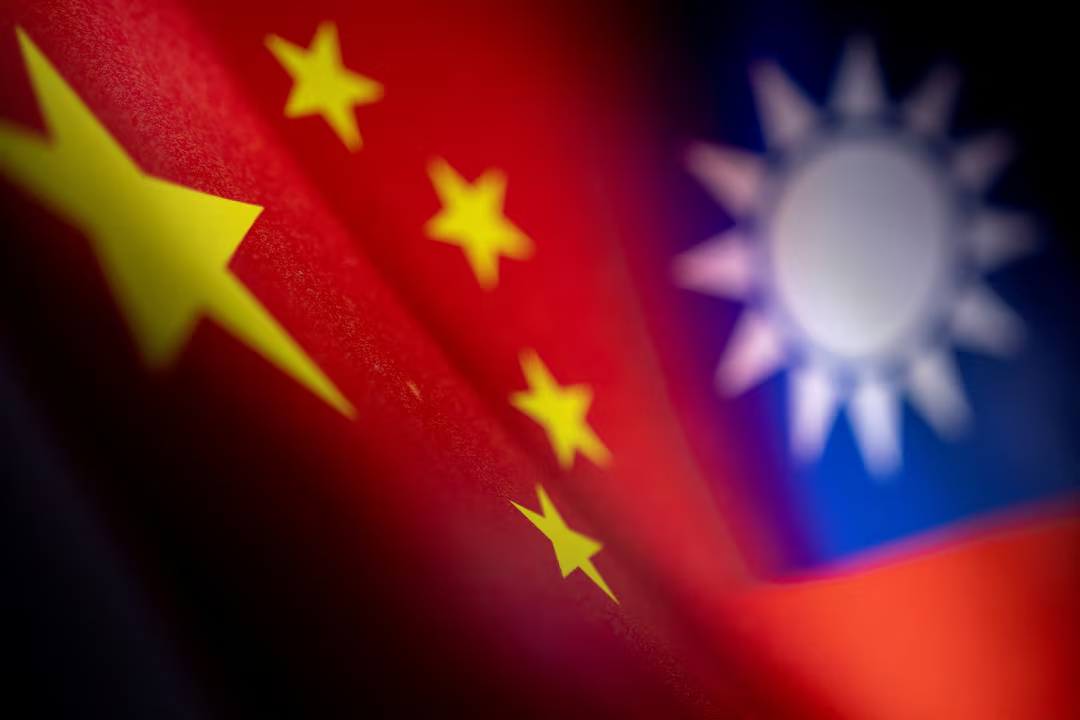
Recently, the Chinese government has been conducting military operations dangerously close to Taiwanese borders. The area separating mainland China and the island is commonly referred to as the “Taiwan Strait.”
As tensions across the Taiwan Strait rise, the consequences are no longer politically theoretical. Instead, they are influencing the everyday decisions of ordinary civilians.
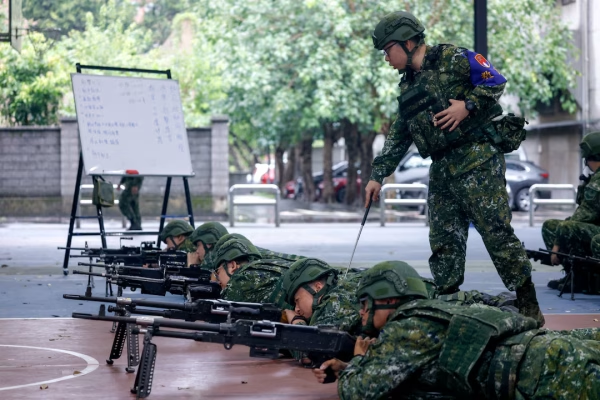
In Taiwan, growing concerns over security and invasion have resulted in a rise in defense spending, an increased military conscription, and reinforced civil defense efforts. Although there is no clear signal that conflict is about to happen, the military drills getting closer to the borders and political uncertainty has created a strong sense of unease. This uncertainty is affecting the way Taiwanese people think about their future, not only in terms of politics, but also their personal, day-to-day stability.
For younger generations and families, living abroad has become one of the most practical ways to escape the crisis.
Traditionally, living abroad has been associated with ambition, career, and most importantly, wealth. However, for some Taiwanese families, it is beginning to take on a different meaning: “preparation”.
Going to universities overseas can provide more than just a degree. It provides access to alternative residency options, international networks, and even a pathway to permanently stay abroad if things go wrong at home. In this sense, moving abroad seems to have become both an investment in a family’s future and their “plan B” against uncertainty.
Japan is highly relevant in this “moving-abroad” trend. Due to its proximity to Taiwan, cultural similarities, and education system, it has become an attractive destination for Taiwanese families who are looking to relocate.
There are around 67,000 Taiwanese residents living in Japan (“Japan to Recognize Taiwan as Place of Origin in Family Registration System”, 2025), making it one of the larger foreign communities in the country. Many of them are students or young adults who have come to pursue education, a career, or long-term opportunities. For these residents, Japan provides a special combination of familiarity and distance. It is close enough to keep their cultural and personal values and habits, yet far enough to provide security and independence.

At St. Mary’s, the representation and recognition of the Taiwanese student/alumni community have also increased. Just last year, in the May school carnival, Taiwanese students and parents were able to have their own independent booth, separate from the Chinese, selling their very own traditional foods and drinks. This indicates a growing sense of Taiwanese identity within the school community, as these students and families are starting to get recognized as distinct rather than being placed in a broad “Chinese culture” category. In addition to cultural celebration, this also reflects increased awareness of Taiwan’s unique sociopolitical context.
Overall, the Taiwan Strait crisis shows how global tension can affect individual lives in subtle but significant ways. For Taiwanese students and families, going abroad is now no longer limited to pursuing opportunities, but also about managing uncertainty.
In Japan, where many of these students choose to study, the impact is already visible. Education in Japan is becoming not only a pathway to success, instead, it is also their way to navigate the waters of their unpredictable home.


