

For the St. Mary’s International School community in Japan (SMIS), the “international lifestyle” has been a symbol of status and opportunity. However, a shift is happening for Tokyo’s global families. As the Japanese Yen faces long-term instability, an occurrence called the “Yen-Trap” is unfolding. This issue puts the “Global Dream” that SMIS students are taught to aim for in jeopardy.
The most immediate effect is the tuition/savings gap. Most SMIS families earn salaries in Yen, but the universities they hope to attend are priced in Dollars or Pounds. When the Yen weakens, the “effective cost” of a four-year degree at a US or UK university can spike by 30% to 40%, even though the tuition fees themselves never change.
This creates a psychological and financial squeeze, as families who were once comfortably in the global upper-middle class now find their money translating less and less across the world. Even if a family’s income stays stable, the cost of global inflation makes them feel less secure.
Japan is being defined as a 格差社会 (kakusa shakai- gap society), where the divide between economic “winners” and “losers” widens. According to Nikkei Newspaper, one in seven individuals in Japan is in the lowest tier of wealth, ranking them sixth out of the G7 member countries. International schools used to be the go-to insurance policy against a stagnant local economy. It provided the skills necessary to exit the Japanese market and enter the global one.

However, the “Yen-Trap” make changes this. If the cost of the “exit” (overseas university) becomes more expensive, students may be forced to stay in Japan. This raises the question: Is staying in Japan a smart economic choice compared to a decade ago? As the Yen loses value, Japan becomes a “cheaper” destination for the world, but for those living within it, the cost of importing a global lifestyle rises sharply.
From a mathematical economics and sociology perspective, we can look at the “return on investment” (ROI) of cultural capital. Traditionally, SMIS students were mathematically more likely to reach the upper-class tier because their English skills and global networks were “scarce goods” in Japan.
Today, that advantage is under pressure from two sides:
- The financial barrier to obtaining an overseas degree is rising.
-
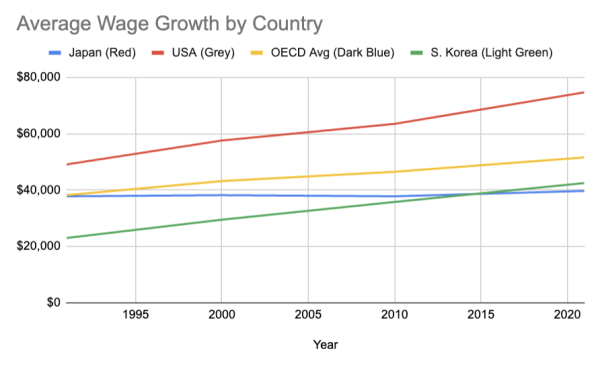
“Average Wage Growth by Country.” OECD Data, 2021, data.oecd.org/earnwage/average-wages.htm. Japanese wages have remained stagnant compared to hubs like Beijing or Bangkok.
Japan still pays its junior employees a respectable starting wage, roughly $56,000 compared to $49,000 in Beijing. However, these very same employees do not get compensated for “climbing the ladder” in Tokyo. According to a 2023 Mercer survey, once you hit the section manager level, a manager in Japan brings home about $100,000, which is actually less than their peers in Thailand ($106,000) and miles below those in Beijing ($140,000). For an SMIS student looking at the long game, the “safe” path in Japan is starting to look like a financial dead end.
If a student earns a degree in USD but returns to work in a JPY economy, they may find themselves having an education that costs significantly more than what they are making.
The international dream is not dead, but it is becoming more expensive. In a changing Japan, the most valuable skill may not just be global fluency, but the ability to adapt to a world where the borders are getting more expensive to cross.
Works Cited
Bank of Japan. (2026). Foreign Exchange Rates (Monthly Average: May 2026). Statistics Search Results. https://www.boj.or.jp/en/statistics/
Mercer Japan. (2023). Total Remuneration Survey (TRS): Compensation Benchmarking and Insights. https://www.mercer.com/ja-jp/insights/total-rewards/compensation/total-remuneration-survey/
Nihon Keizai Shimbun. (2024, May 14). 中流消滅、7人に1人が「最下層」 格差データが示す日本企業の罪 [The Disappearance of the Middle Class: 1 in 7 in the ‘Bottom Tier’]. https://www.nikkei.com/article/DGXZQOUC1441H0U5A011C2000000/
Souma, Hideki. (2024, April 21). “Wages rose a paltry 10% over Japan’s ‘lost three decades.’” The Asahi Shimbun. www.asahi.com/ajw/articles/15166586.


