
While the Christian persecution complex grows in America, it overshadows a very real prejudice against atheism in politics, in both principle and action. An open atheist has never held any significant office in United States history. Women, people of color, sexual minorities have begun to appear, yet there remains a palpable taboo with those who profess no religion.
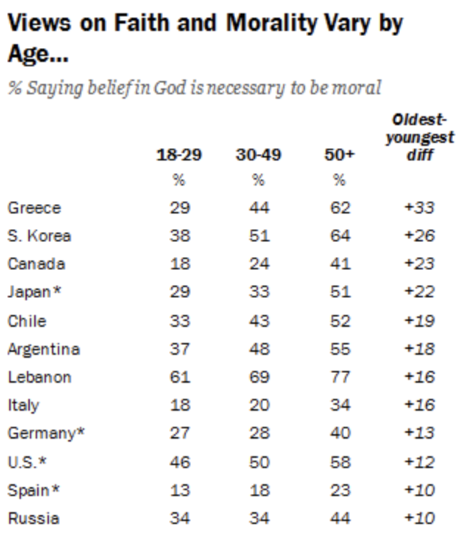
This bias was most effectively demonstrated by Clifford and Gaskins in 2017, finding an unconscious bipartisan bias for religiously presenting public figures over atheist ones, even concluding that such religious displays may disingenuously “serve an ideological purpose.” A 2014 poll reveals just over half of Americans see belief in God as essential to morality. This is intensified in the particular evangelical brand of many Republicans, who deem Christianity as the basic source of moral guidance. As Ted Cruz succinctly surmised, “Any president who doesn’t begin every day on his knees isn’t fit to be commander in chief of this nation.” (He might be surprised by some of the things Jefferson had to say) Such bias, which is not exclusive to the evangelicals, is predicated on the correlation of religion with morality and the opposite for atheism. This association is fallacious and dangerous.
The argument traditionally is that those without God have no “objective standard” to determine what is right and wrong, depicting them as a sort of callous psychopath with no mechanism for morality, and thus unfit for office. However, this objection is invalid. Christians don’t have an objective standard either. See it this way. Why ought we not kill? The Christian may answer with some secular explanation, forgetting to mention God such as “it infringes upon a human’s dignity.” This is an irreligious (even atheist!) moral basis, absent of a God. But if they do say something along the lines of, “Because people are made by God and we must value God’s creations,” you counter, “Why must we value God’s creations?” Now allow this game to continue until the Christian gives up or arrives at the defence of “Because God says to,” to which you respond, “Why must we do what God says to?” Here, then, you and hopefully they will see that religious people face the same problem atheists do: there is no solution to this problem of finding a moral basis—it is an endless game of why. While an important philosophical question, it has no bearing when judging an individual’s morality, much less political competence.
Second, religion does not determine morality. Christians do not derive their morals from the Bible—yes, it may seem surprising, but it is clearly true. Morals are determined cognitively, likely by a combination social circumstances and innate factors (roughly, culture and biology) — such is the continual scholarly consensus. Thus, religion and its morality changes with society. To demonstrate this, consider slavery. Christian politicians (and all Christians, hopefully) today oppose slavery — ask why and they may point to a number of verses. Yet a few centuries prior, Christian societies were dominated by slavery. Indeed, reading the Bible, it is easy to find a proslavery worldview. There are the commands in Leviticus 25:44 for the Israelites to take foreigners as slaves (no, not “servants” or “butlers” as some apologists may claim) and bequeath them to their children (and no, this was not a “social safety net”). Indeed, even in the New Testament, Paul calls on slaves to obey their masters (Eph 6:5-9). Even if in the same chapter, Paul tells masters to treat slaves well, he makes no move against the institution. In the whole Bible, there is no semblance of doubt cast on the actual institution of slavery; instead, slavery is an assumed reality, which is to be expected from human writers in a time when slavery was an assumed reality in society. Christian societies afterward continued to tolerate slavery, especially when it became profitable. Yet, come the Enlightenment, something changed in a few Christians who became the forefront of the abolitionist movement. They reinterpreted the Bible and found new ways to harmonize Christianity with their new aversion to the horrors of slavery. As historian J. Albert Harril explained, the “new generation of abolitionists adopted a different hermeneutical strategy, the search for immutable principles in the New Testament,” in order to bypass plain text readings in favor of broader thematic readings that would conceptually support antislavery positions. Appealing to concepts such as creation in the image of god (Gen. 1.27) or Jesus’s Golden Rule (Matt. 7.12), they could override proslavery passages by promoting some overarching ideas over others (Harrill 153).
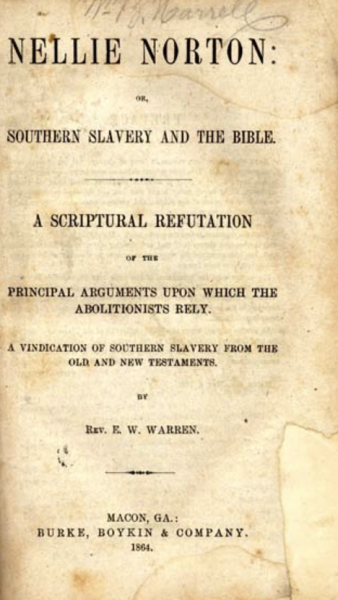
They had to reinterpret, much to the horror of anti-abolitionist Christians, using the same Bible. To be a Christian, one must negotiate with the biblical text—you cannot take it at face value, because it is multi vocal about several moral issues (it was written by dozens of authors across perhaps two millennia), and it can often conflict with modern moral developments. Religious people must reinterpret, redefine, and prioritize some parts over others—no Christian is immune to this. If you are a “Bible-believing” (whatever that means) Christian and oppose slavery, you have already negotiated with the text.
Religious people don’t derive their morality from a holy text or magisterium; it is their inner moral intuition (that slavery is evil) or societal pressure that causes them (or their priest/pastor) to read their ideas (ie. antislavery) into the text (not the other way around). They derive it from their respective interpretive traditions, which, in turn, depend on their social setting. Their own moral intuition takes precedence over and against the Bible, no matter how much they profess their devotion to it. Their interpretation of the Bible is shaped accordingly. Really, a Christian person’s morality comes from what they’ve evolved to prioritize, learned from their parents, from authority figures, from friends, from media, and they may privately think about and develop that morality, like any person. Like an atheist.
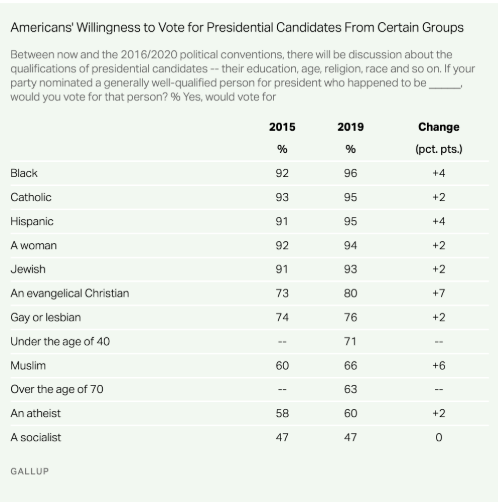
Another 2019 Gallup poll on factors affecting Americans’ likelihood to vote for potential presidential candidates found atheists at 60% to a highly unpopular group, just under Muslims (66%) and only above socialists (47%). Now, seeing that a socialist Muslim has just been elected mayor in America’s largest city, the poll seems at best outdated. Let us forget this irrational fear of irreligion and judge character by different metrics.
Works Cited
Bible. The Holy Bible, New International Version. Zondervan Publishing House, 1984.
Clifford, Scott, and Ben Gaskins. “Trust Me, I Believe in God: Candidate Religiousness as a Signal of Trustworthiness.” American Politics Research, vol. 44, no. 5, 2016, pp. 866-97.
Cruz, Ted. Quoted in “The Brief: Nov. 10, 2015.” The Texas Tribune, 10 Nov. 2015, https://www.texastribune.org/2015/11/10/brief-nov-10-2015/.
Gallup. “Socialists, Atheists Still Face Steepest Climb to Presidency.” Gallup News, 11 Feb. 2020, https://news.gallup.com/poll/285563/socialists-atheists-still-face-steepest-climb-presidency.aspx.
Harrill, J. Albert. “The Use of the New Testament in the American Slave Controversy: A Case History in Hermeneutics.” Religion and American Culture: A Journal of Interpretation, vol. 10, no. 2, 2000, pp. 149-86.
Jefferson, Thomas. The Life and Morals of Jesus of Nazareth. Edited by Cyrus Adler, Government Printing Office, 1904.
—. “Letter to the Danbury Baptists.” 1 Jan. 1802. Library of Congress, https://www.loc.gov/loc/lcib/9806/danpre.html.
Pew Research Center. “Atheists and Agnostics Know More About Religion Than Prophets Do.” Pew Research Center’s Religion & Public Life Project, 16 July 2014, https://www.pewresearch.org/religion/2014/07/16/how-americans-feel-about-religious-groups/.
Warren, Ebenezer W. A Scriptural Vindication of Slavery. 1861. Negro Universities Press, 1970.

