












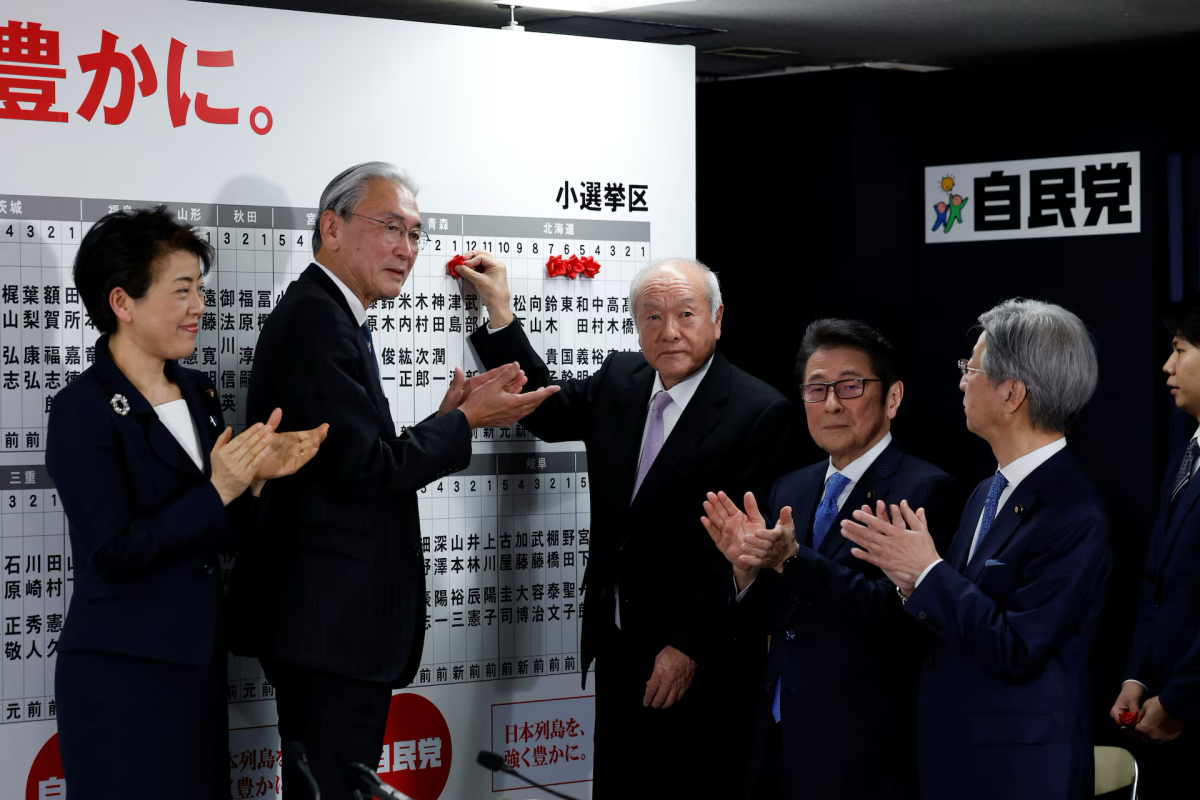
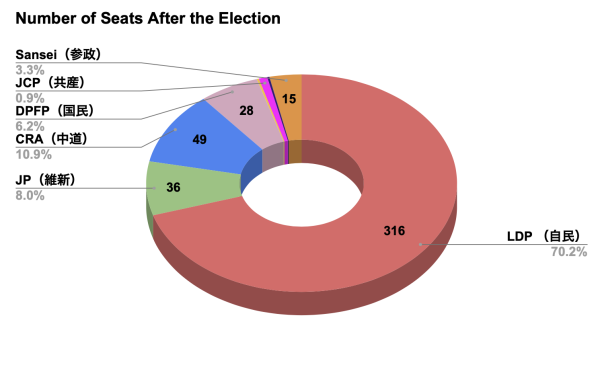
The Liberal Democratic Party (LDP) won a decisive victory in the recent national election, securing 316 seats in the House of Representatives. This gives the party more than a two-thirds majority, making it one of the strongest governments in recent years. With the alliance between the Japan Innovation Party (JP), they have a total of 352 seats, meaning that they have the majority of seats in the House of Representatives.
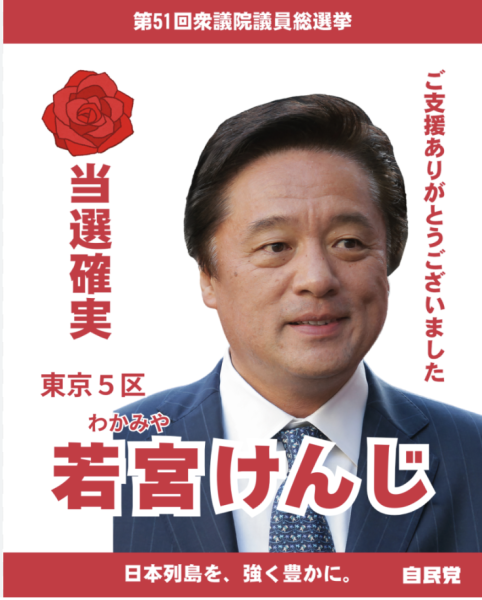
This victory marks a major turnover from the previous election, when the LDP under Ishiba’s leadership suffered a major defeat and lost control of the government, with only 198 seats. In that election, voters expressed dissatisfaction with the ruling party over economic concerns, political scandals, and leadership instability. The loss forced the LDP into opposition and led to internal debate about its direction and leadership.
With its current 316-seat majority, the LDP can now override decisions made by the House of Councillors (参議院) if they disagree. This power allows the ruling party to pass thinkings even without upper-house approval. In addition, the LDP now has the numbers needed to initiate changes to the Constitution (憲法改正), a rare level of authority that only a very strong government can achieve.
Despite its overall victory, the LDP also experienced internal changes. Many Centrist Reform Alliance members and veteran lawmakers lost their seats, including long-serving politicians known for compromise and experience. Analysts believe this could shift the party’s direction, giving more influence to younger or more ideologically strong members.
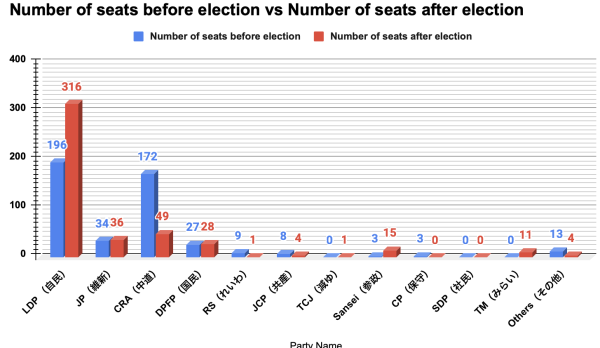
Other political parties had mixed results in the election.
The Centrist Reform Alliance of Japan (CRA) remained the largest opposition party but failed to gain enough seats to seriously challenge the LDP, with only 49 seats. The party focused on protecting the Constitution, social welfare, and government accountability, but struggled to expand its voter base. Veteran members such as Ichiro Ozawa (won 19 times, former DPJ leader) , Yukio Edano (won 11 times, former CDP leader), and even the chief secretary of their party Jun Azumi lost to LDP candidates, and lost their seats.
The Democratic Party for the People (DPFP/国民) saw a slight increase, rising from 27 to 28 seats. While stable, the party was unable to significantly expand its influence.
Several smaller parties lost support. Reiwa Shinsengumi (RS/れいわ) dropped sharply from 9 seats to 1 seat, while the Japanese Communist Party (JCP/共産党) declined from 8 to 4 seats. Both parties struggled to maintain voter backing nationwide from liberal supporters.
Some newer or smaller parties gained attention. Sansei Party (参政党) made a major breakthrough, jumping from 3 seats to 15 seats, showing growing support among certain voters. Team Mirai (TM/みらい) also made a strong debut, winning 11 seats after holding none before the election. TCJ(減ゆ) gained its first seat with their leader Takashi Kawamura winning a seat, moving from 0 to 1.
On the other hand, the Conservative Party (CP/保守) lost all its seats, falling from 3 to 0, while the Social Democratic Party (SDP/社民党) failed to win any seats.
As the new Diet begins, Japan now faces a political situation where one party holds overwhelming power. With opposition parties weakened and many veteran lawmakers gone, the coming years will test how responsibly the LDP uses its authority and how effectively other parties can represent different voices in Japanese society.
