



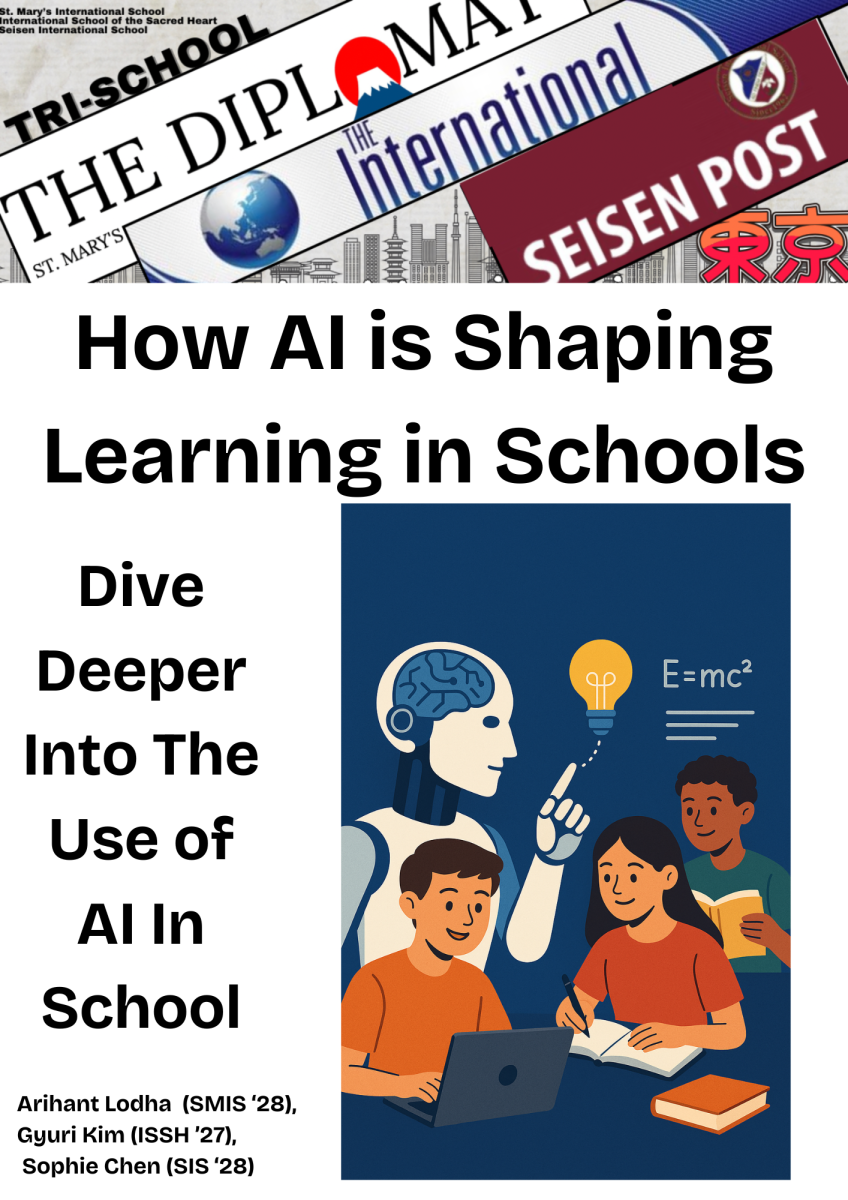




14-year-old John got far more than he bargained for when he unleashed an overzealous suite of generative AI tools into his grueling Middle-school curriculum at St. Mary’s International School this semester. As an arriving freshman next year, he must navigate through the pressure and rigorous academics. “AI would surely accelerate my learning and expand my perspectives,” he once stated as he began using generative AIs as tools in his early 8th grade career. His packed schedule rarely left time for deep, unhurried reading, creating an environment where humanity’s natural capacity for deep thought was reframed as an inefficient luxury. “The workload in 8th grade compared to 7th or 6th grade is a massive, but truthful difference.” claimed Yasuhiro(‘30’), a student source, exposing how the sheer volume of material strips away cognitive bandwidth. “What 8th grade seemed like at the start of the year was very different from the assignment expectations in the later quarters.” He further elaborated, showing how expectations grew exponentially from the start of the year.
The stark reality of this shift collided with student John during a high-stakes literature seminar in the senior commons, when his flawlessly structured, AI-prompted Article analysis collapsed under a sudden five-minute cross-examination by his instructor. As faculty scramble to redefine academic integrity in the school handbook, the student body faces an invisible crossroads where the line between an intellectual catalyst and a psychological crutch has never been more dangerously blurred.
Accustomed to spending hours outlining essays from scratch during his middle school years, seeing the rapid, frictionless outputs of tools like ChatGPT Plus and Gemini Advanced presented an allure that was nearly indistinguishable from genuine intellectual transformation. Through a kind of digital coagulation, these platforms promised to reconstruct complex strings of critical thinking into an instant solution. After extensive research on student tech forums, Reddit’s coordinator threads, and AI productivity blogs, John took a definitive step into this modern digital frontier, integrating AI directly into his daily study workflow until its presence became inseparable from his own academic routine. Ranging from free basic models to premium subscriptions costing thousands of yen a month, he settled on a combination of a paid ChatGPT account and Google’s NotebookLM for synthesizing dense texts.
“Advanced AI tools are shifting rapidly, and the best ones with features like source-grounding and long-context windows can be tricky to master, but they feel essential if you’re drowning in rubrics,” one student observed in the survey. “Honestly, the use of AI has been good for my learning, it helps me understand material I wouldn’t have had the time to process otherwise,” another has outlined, showing simply how the use of AI differs and changes in opinion from each perspective.
He decided on utilizing NotebookLM to construct a digital knowledge base of his literature texts, taking advantage of features like instant thematic mapping, cross-referencing, and generating structurally sound essay outlines, a mechanism that transformed a chaotic syllabus into a perfectly ordered system of efficiency. Ever inclined toward a smarter, more streamlined study routine, John integrated the AI suite into a digitized workflow of iPad note-taking apps, Quizlet flashcards, and his digital calendar to-do list. The instant summarizing feature was its most compelling selling point, where he imagined walking into his assessments with fully synthesized arguments, relying only on a digital co-pilot that operated his mind for him, in the efficiency that was required. He recalled the feeling of initial triumph, where the tool seemed less like an external program and more like a natural extension of his own cognition. “There was an incredibly high hope that these tools would completely rewrite how we study,” one student reflected in the survey. “It could break down a 400-page novel on a schedule while you were focusing on math, and it does it with absolutely flawless grammar and structure,” John, in his enthusiasm, jokingly referred to his heavily prompted digital workspace as his Silicon Valley ghostwriter, unaware of how thoroughly the system had begun to ventriloquize John’s independent voice.
Rather than receiving a flawless academic assistant, however, John more often found himself working to serve its automated needs, correcting subtle hallucinatory mistakes that threatened to expose the emptiness beneath the surface. The semi-intelligent algorithm would indiscriminately absorb conflicting literary theories, misattribute quotations, and smooth over crucial textual nuances if left unchecked, a nefarious trick of language where sophisticated jargon masked a fundamental flattening of human talent and skill. “I believe it only sort of diminishes the human mind,” Teacher, Mr. Joselito Ebro stated, before continuing: “But used correctly as a tool or an assistant can be powerful as a wall that bounces your ideas.” Students recalled instances in which an AI-generated outline had hallucinated page numbers or entirely missed the entire satirical tone of an assigned text, demonstrating that compliance with the software required a quiet surrender of critical faculties. “The use of AI has genuinely hurt my learning,” another student stated plainly in the survey.
The consequences of this relationship came into sharpest focus during a high-stakes literature seminar in the senior commons. John AI-prompted Essay analysis had safely bypassed the school’s text-matching software, providing a false sense of security. However, during a sudden, unscripted five-minute Socratic cross-examination, his instructor bypassed the polished text and questioned the core premise of the thesis directly. The argument collapsed almost immediately. The elegant vocabulary that had been present throughout was simply a literary makeup, as under a single question, the entire thesis and argument of this analysis seemingly disintegrated. John sat in silence, avoiding eye contact with his teacher, putting a finger under his chin as if he were thinking of something elaborate, while in truth, he had been lost.
Although generative AI tools have come a long way, they still cannot function without rigorous human intervention. While higher-priced premium models may prove more articulate, the current landscape remains treacherous for students, offering efficiency at the cost of individual thought. Faculty at St. Mary’s have begun adapting, implementing mandatory viva voce oral defenses and handwritten in-class diagnostics to disrupt the internalization of passive obedience and ensure genuine comprehension.
John has since altered his strategy, diligently organizing his own primary reading notes before ever opening a prompt window, refusing to let the software dictate his cognitive architecture. He has learned to treat the AI’s output with intense skepticism, evaluating its generated ideas critically before implementing them. “I think treating the AI like an entry-level intern is key,” one student remarked in the survey. “They need constant supervision and boundaries. When the AI makes a mistake, or when I can’t defend its logic, I need to do better as the actual human in charge. I don’t really mind how students use it, as long as they are genuinely learning themselves. That’s what matters.” His change in mind seems to be a great relief for John, as he begins to shift from an AI-dependent life to operating it in his own, comfortable ways.
Despite the setback, those tracking the shift suggest that students do not regret the integration of technology into the classroom. Instead, the focus has shifted toward finding a sustainable equilibrium, with many eager to see how upcoming, more logically robust AI iterations will challenge or support the next generation of learners. The quiet revolution at St. Mary’s continues, but the rules of engagement have fundamentally changed. The reality of the modern classroom suggests that the answer lies not in the severity of the workload, but in the sincerity of those choosing the shortcut, when a hyper-tech environment promises academic protection at the cost of individual freedom, and when its citizens have been shaped to feel that this bargain is fair, the tyranny achieves its ultimate, terrifying perfection.