












For the past 15 years, Japan’s population has been gradually decreasing, but this year, it hit an all-time low of 124 million. This issue has been uncovered for a while; however, recently, this has become a great problem since it has come with economic decline. This decline can lead to the downfall of the Japanese economy, an economy that was highly looked up to, but due to things like the aging labor force, the economy is losing its value.
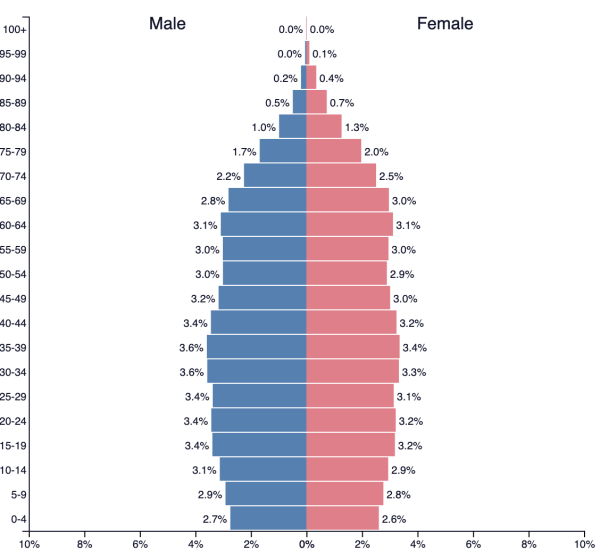
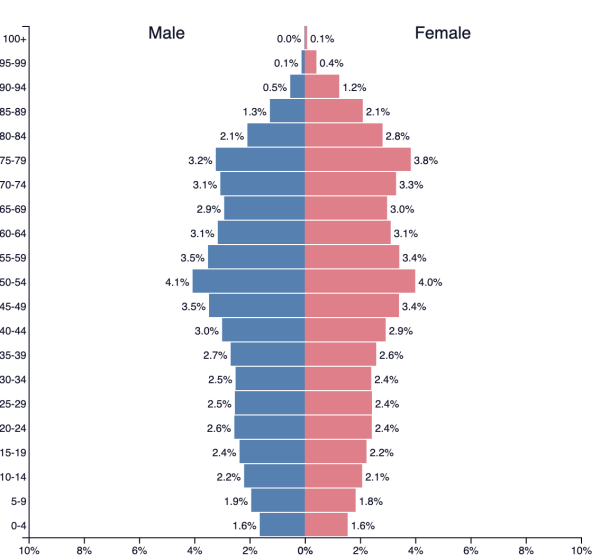
The issue originally started in 1949, when low fertility began. The population was increasing until 2009, but in 2011, the first significant decline occurred. The population has decreased from 128.06 million to 127.8 million people. Although this may not seem significant, this clearly is a big decline since a few years before, when it was going in an upward trend. The population never went up after that; it slowly decreased. The following is the population pyramid for the United States. As you can tell, the population pyramid has youth upcoming, people who can replace the retired workers. Conversely, the Japanese population pyramid shows the middle-aged as the most prominent on the graph. This imbalance in age distribution not only affects demographics but also has significant economic implications, as the shrinking workforce and changing population structure put increasing pressure on Japan’s economy.
This population decline has led to economic and social consequences, which could ruin Japan. Jobs in Japan are going to have much more pressure due to the lack of people in the labor force. This is because the current workers are retiring, which weakens the workforce and leads to less demand and less input, weakening the economy. According to a researcher who researched the Japanese population decline, Hassan, he says that Japan is currently in a “vicious cycle”. He explains the “vicious cycle” as a cycle where there are “continued low fertility rates,” which leads to reduced social support for the younger population. This also leads to economic pressures like “longer working hours and higher taxes, discouraging family formation”, creating the cycle aspect. On the social aspect, rural depopulation will most likely occur. This is because rural people will move out for opportunities which opened due to the retiring population, but also the lower birthrate will be a bigger issue, as most old or rural places are run by elders. This is an issue because rural places hold cultural aspects with value. If people in rural areas move out, rural places will disappear, which can lead to the disappearance of cultural aspects. Additionally, rural depopulation can also lead to less agriculture, affecting imports and the economy.
The population decline comes from many reasons, mainly the economic and cultural norms. The high cost of living makes it difficult for many people, especially the younger generation who have just gotten out of college, to afford to raise a family. Housing prices in cities like Tokyo are high, while wages have barely increased over the past decades, making the yen lose purchasing power. Although inflation has risen, most companies have not compensated by raising salaries enough for people to keep up with inflation, which ultimately reduces people’s income. Also, things such as childcare and education can cost parents. This leads to the cultural aspect of Japan. Japan is a country known for its rigorous education system. People are unable to keep up with their studies without things such as cram school. This is a cost that people have to pay for their children to succeed. Another cultural aspect that is the cause of this problem is how women often work jobs. In Japan, it is frowned upon to leave a job to raise a child. This social expectation has led women to work instead of giving birth to the future of the country.
All problems have solutions, just like this one. Firstly, the government and companies must compensate workers’ wages to match inflation. This rise in wages would take off or reduce the financial burden on the younger generations. Providing affordable housing and increasing or making childcare subsidies would make it easier for people to have families. Making access to education, including cram schools, easier can also significantly reduce parents’ monthly expenses. On the cultural aspect, workplaces should promote more flexible work arrangements, such as remote work and parental leave. If they provide paternity leave for women, this would add more incentive for women to have babies, but also let them still keep their careers. Additionally, remote work can also benefit the company because employees can still work from home while taking care of their families, which can also apply to men. Also, changing social expectations about women’s roles in the workforce and encouraging them to have a family would help with population increase. Therefore, these solutions are feasible and could make the Japanese economy much more stable, making Japan a successful place long term.