












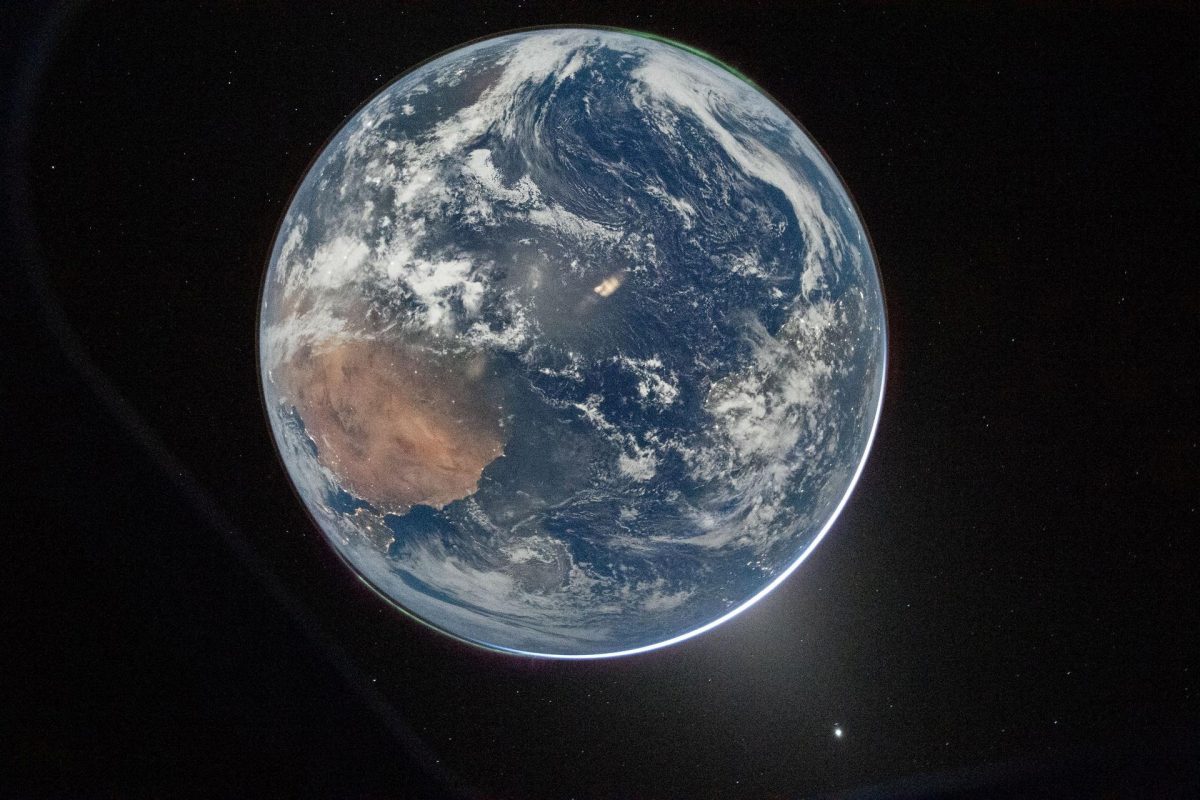

In 1972, the crew of Apollo 17 captured the iconic “Blue Marble” photo, a single photograph that reshaped how we view earth. As the Artemis II mission returns to the moon’s orbit, we are witnessing the birth of a “Modern Blue Marble.” While the original was a stunning film-based photo, the Artemis images are captured with ultra-high-definition digital sensors. This new image feels different. Unlike the cameras of the 70s, these capture a more realistic, subtle palette that includes the soft grays of thick cloud cover and the true, hazy layers of our atmosphere. While it might look less vibrant, this realistic color profile provides a much more accurate record of our planet’s current state, showing us the Earth as it truly appears in deep space.
A groundbreaking aspect of the Artemis II mission is its capacity for high-speed data transmission through the Orion Optical Communications System. Because the spacecraft is equipped with these laser-based data links, it acts as a high-tech scout for future lunar explorers. One of the most exciting scientific applications is the Lunar Observation Campaign. From their unique vantage point orbiting the Moon, the crew will observe and document impact flashes as meteoroids strike the lunar surface—events that provide critical data on the density of space debris in the lunar environment. By cataloging these impacts as they happen, scientists can better understand the risks to future lunar bases and improve the safety strategies for humans living on the Moon’s surface.
According to official updates from the Artemis II mission, the Artemis II crew recently reported seeing distinct shades of browns, tans, and even subtle blues that are invisible from a distance. These color nuances are the indicators of the Moon’s mineral diversity; for instance, areas rich in iron and magnesium tend to look more brownish-gray, while high concentrations of titanium can give lunar basalt a faint bluish tint. Beyond what the human eye can see, missions like India’s Chandrayaan-1 and NASA’s Galileo have used multispectral imaging to create false-color maps, where vibrant oranges, greens, and purples are used to represent specific minerals like olivine and pyroxene. These colors allow scientists to map the crust’s chemical history, proving that the Moon’s hidden side is very different from what we see.
The Artemis II mission uses modern imaging and fast data transmission to deepen our understanding of Earth and the Moon. By capturing realistic views of our planet and mapping the moon’s minerals, the crew gathers practical data for researchers. These clear observations will help scientists plan safer lunar exploration in the years ahead.