






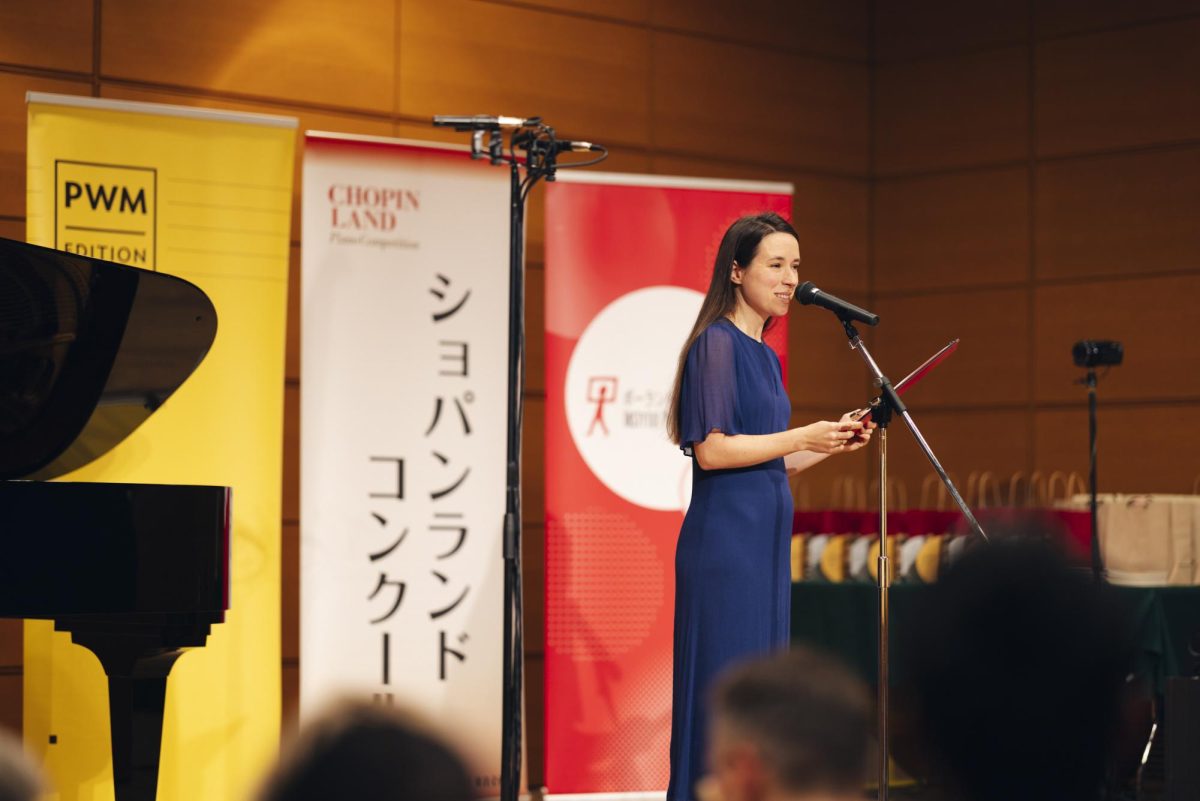
For the past five months, Ms. Joanna Baranowska has been sharing Polish culture in Japan, bringing art, music, and cultural projects to new audiences.
Although Poland and Japan are far from each other, Ms. Baranowska believes the two nations have similar sensibilities. “We, Poles and Japanese, outwardly seem very practical and matter-of-fact, yet we are huge romantics inside,” she explains. “This makes us great partners in cultural exchange, as we can emotionally grasp the essence of each other’s art.”
Despite these intersections, the essence of some elements of Polish culture is difficult to fully grasp by Japanese audiences. “A lot of Polish art is steeped in our sometimes very difficult and highly contextual history. Japanese people know basic facts, but certain historical or cultural context may be tricky.” She says they get past this by linking things that Japanese audiences respond to emotionally-like Chopin’s music-to the historical backdrop that gives it gravity. “We use points where we have the most understanding to expand and deepen interest in our country,” Ms. Baranowska says.
Even in a short time in Japan, Ms. Baranowska has seen the impact of cultural projects firsthand. One recent example was a photo exhibition organized by the EU Delegation to Japan, featuring Belarusian artist Sasha Velichko, who found safety in Poland after being targeted by the Lukashenko regime. Her work explores misinformation, AI, and fake news—topics Ms. Baranowska believes are especially relevant today. On a more hopeful note, she was moved by the “Chopinland” competition gala, where young pianists from ages five to young adults performed music by Polish composers. “Seeing those kids inspired by our music reminded me that these prizes might be their first steps toward great careers,” she says.
When considering which cultural projects to introduce in Japan, Ms. Baranowska says, the selection is done with two leading questions in mind: “What do our Japanese audiences want?” and “How do we want to present our country in Japan?” Popular cultural figures, like Chopin or film director Andrzej Wajda, often provide a spotlight, under which other projects are introduced. She also encourages light-hearted events, such as the annual Polish Festival in Roppongi Hills, to entertain audiences in interactive ways. It is through such involvements that Ms. Baranowska aspires to assist Japanese audiences with a deeper understanding of Polish culture. “Cultural exchange is not just about teaching facts—it’s about building emotional bridges,” as Ms. Baranowska would say.